
Who Bears the Risk When AI COI Compliance Software Gets It Wrong?



It's one of the first questions compliance teams ask when AI enters the conversation, and it’s the right one.
If an AI platform reviews a certificate of insurance, flags it as compliant, and a claim is later denied because a critical endorsement was missing. Who absorbs that? The platform? The vendor? Your team?
The question isn't paranoid. It reflects something real: Some AI systems make errors. Insurance documents are complex, inconsistently formatted, and full of nuance that matters enormously when a claim is on the line. Asking who's accountable when something goes wrong isn't a sign of AI distrust. It’s a sign of operational maturity.
Here's what construction firms, manufacturing operations, and property management portfolios actually need to know.
Does AI COI Compliance Software Take On Your Liability? No, and Here’s Why That’s Actually Fine.
Let's be direct about something the industry sometimes dances around: no AI platform, regardless of how accurate it is, assumes your organization's legal or regulatory compliance liability. That responsibility lives with you.
This isn't a limitation of the technology. It's how risk and accountability work in every professional context. Your accounting software doesn't take on tax liability if it miscalculates a deduction. Your contract management platform isn't liable if a clause slips through unsigned. AI in COI compliance operates on the same principle: it's a tool that extends your team’s capacity and accuracy, not a third party that absorbs your exposure.
Understanding this upfront changes how you should evaluate any platform. The question isn’t "Is the AI infallible?" Because it isn’t, and any vendor who implies otherwise isn’t being straight with you. The better question is: How does this platform reduce the probability of error, and what should we do when an edge case arises?
What’s the Difference Between OCR and Contextual AI in COI Compliance? More Than You’d Think.
Not all AI in COI compliance is the same, and the difference matters for construction projects, manufacturing vendor programs, and property management portfolios managing large teams of subcontractors.
Older platforms use OCR (optical character recognition) to extract text from documents and match it against a checklist. It reads what's there, but it doesn't understand what it's reading. A COI can pass an OCR check and still be non-compliant if:
- An endorsement is named incorrectly
- A coverage limit is present but structured to exclude your project or location
- The named insured doesn't match the contracting entity
- An ACORD 25 or ACORD 28 field is technically populated, but doesn't meet your contract thresholds
Contextual AI, the kind illumend, from myCOI, uses, reads documents the way a knowledgeable compliance reviewer would. It understands the relationship between coverage types, interprets endorsement language against your specific requirements, and flags ambiguity rather than auto-approving it.
It's trained on the specific document types, coverage structures, and endorsement patterns your team actually encounters, not generic insurance data. It’s AI you can trust because it was built by the myCOI team, who reviewed more than 45 million documents over 16 years. That's not a marketing distinction. It directly affects what kind of AI they built, and what kind of liability isn’t allowed to slip through a review, so nothing ends up in a claim.
What to ask any vendor:
Request documented accuracy rates on complex documents: layered coverage structures, unusual endorsements, non-standard ACORD forms. Ask specifically whether the platform validates against ACORD 25 and ACORD 28 standards, and whether it flags discrepancies between the certificate holder and the contracting entity. The answer tells you whether the platform is built for real-world compliance situations.
Does AI COI Compliance Software Still Need a Human in the Loop? Yes, Just Not for Everything.
Here's where the liability conversation gets practical.
The platforms that reduce your risk exposure most effectively aren't the ones that promise to eliminate human review. They're the ones that focus human attention where it actually matters: the edge cases, the escalations, the documents that fall outside standard parameters for your construction contracts. Think manufacturing vendor requirements, or your property management agreements.
When a document is flagged for your review in illumend, you're not walking in blind. The platform surfaces exactly what it found, why it flagged it, and what the gap means in the context of your specific coverage requirements. Your team isn't just approving or rejecting. They’re making judgment calls backed by data and context that a spreadsheet, a third-party service, or a stack of PDFs could never provide in real time.
When someone on your team approves an exception or overrides a flag, that decision is documented, timestamped, and auditable. That's a stronger defensible record than "the software said it was fine." It’s a sharper record than "someone reviewed it" with no trail of what they actually saw or knew at the time.
What Happens When the AI Is Wrong
It will be, sometimes. Here's what that looks like in practice, and why it matters less than you might think if the platform is set up correctly.
A well-designed AI compliance platform doesn't just give you a binary compliant/non-compliant output. It shows its work. It tells you which fields it evaluated, what values it found, and why it reached the conclusion it did. When something is flagged as compliant that shouldn't be, that audit trail is your first line of defense, both for correcting the error and for demonstrating that your process was sound.
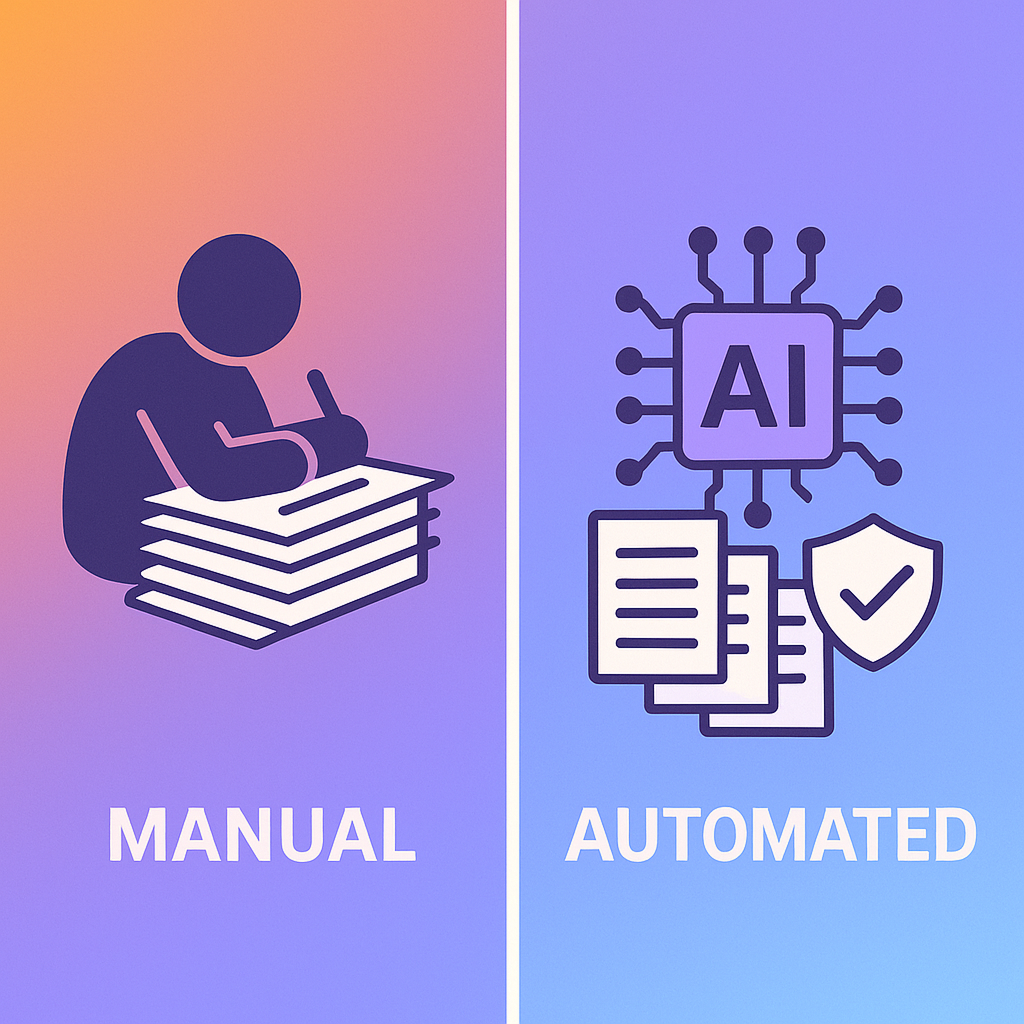
Manual process vs. AI platform: where liability actually lives
| Manual / Spreadsheet Process | AI Platform (illumend) |
|---|---|
| Errors are silent: no record of what was missed | Errors are visible: platform shows its work |
| No audit trail for approved documents | Every decision documented and timestamped |
| Escalation depends on who's available | Structured escalation path with full context |
| Gaps surface at claim time | Gaps flagged before they become exposure |
| Compliance liability: same as with AI | Compliance liability: same as with manual, but better documented so you can do root cause analysis |
| ACORD 25 / ACORD 28: checked manually, inconsistently | ACORD 25 / ACORD 28: validated automatically against contract requirements |
The relevant comparison isn't "AI platform with occasional errors" versus "perfect manual process." It's "AI platform with documented, auditable decisions" versus "manual process with undocumented gaps." The latter is the liability exposure most compliance teams are actually living with right now, in construction, manufacturing, property management, and government procurement alike.
What Should You Ask Before Buying COI Compliance Software? Start Here.
Before you commit to any AI-powered COI compliance platform, these questions separate the confident purchases from costly mistakes. They're a starting point: our full guide on how to evaluate AI-powered COI compliance software walks through all 10 in depth:
- On accuracy: What's your documented accuracy rate on complex documents: layered endorsements, non-standard ACORD forms, unusual coverage structures?
- On ACORD compliance: How does the platform validate against ACORD 25 and ACORD 28 standards? Does it check the certificate holder name against contracting entity requirements?
- On transparency: How does your platform document compliance decisions? What's the audit trail when a document is approved, rejected, or escalated?
- On escalation: What happens when the AI isn't certain? Is there a human-review option, and what information does your team see when a document is flagged?
- On integration: How does the platform connect with existing risk management workflows and procurement systems?
- On liability: What contractual protections do you offer? What's covered under your MSA if a platform error contributes to a compliance gap?
- On model currency: How often are your models retrained? Who's responsible for keeping them current as insurance forms and ACORD standards evolve?
Is Your Manual COI Process Riskier Than the AI You’re Worried About? For Most Teams, Yes.
Most compliance teams evaluating AI platforms are already operating with significant undetected risk. They just can’t see it because manual processes don't produce audit trails for what they missed.
The COI that looked fine but had a coverage gap that didn't surface until a claim. The renewal that slipped through because someone was out. The subcontractor who updated their policy mid-project but never re-submitted. The vendor whose ACORD 25 certificate listed incorrect limits for your project specifications.
These failures happen constantly in manual processes, in construction project management, in manufacturing supplier programs, in property management vendor networks. They’re invisible until they're expensive.
AI doesn't eliminate compliance risk. Nothing does. But a well-implemented AI compliance platform makes your risk visible, your process auditable, and your team's attention focused on the exceptions that actually warrant it. That's not a liability transfer. It's a liability reduction.
Frequently Asked Questions
Q: Does AI COI compliance software take on liability if it makes an error?
No. AI compliance platforms do not assume your organization's legal or regulatory compliance liability, and this is true of every platform on the market. Liability for compliance decisions lives with your organization, just as it does with your accounting software or your contract management platform. What a well-designed AI platform changes is the quality of your decisions and the strength of your documentation, both of which reduce your practical risk exposure significantly.
Q: What happens when AI COI software makes a mistake?
In a well-designed platform, errors are visible and auditable rather than silent. illumend, from myCOI, shows its work, documenting which fields were evaluated, what values were found, and why a compliance determination was made. When an edge case arises, the platform flags it for human review with full context rather than auto-approving it. This audit trail is your primary defense in a claim scenario: it demonstrates that your organization had a sound, documented compliance process in place.
Q: How do I protect my organization when using AI for COI review?
The most effective protection is choosing a platform with three characteristics: contextual AI that understands endorsement language rather than just OCR text extraction, a structured human-in-the-loop escalation path for edge cases, and a full audit trail that timestamps every compliance decision. illumend provides all three, built on 16 years of compliance expertise and 45M+ documents reviewed. The goal isn't eliminating AI from the process. It’s ensuring that when a decision is made, there's a defensible, documented record of how it was reached.
Q: Is AI COI compliance software accurate enough to replace manual review?
The more useful framing is this: AI compliance platforms are more consistent and more auditable than manual review, even if neither is perfect. Manual review by non-insurance specialists produces errors too, but those errors are undocumented. A platform built on 45M+ documents and 16 years of compliance expertise, with structured human escalation for complex cases, produces a better compliance record than a spreadsheet process, not because the AI is infallible, but because every decision it makes is visible, correctable, and traceable.
Q: Does COI compliance software validate against ACORD 25 and ACORD 28 standards?
Leading platforms do, and this is a critical capability to verify during evaluation. illumend validates certificate data against both ACORD 25 (certificate of liability insurance) and ACORD 28 (evidence of commercial property insurance) standards, checking coverage types, limits, endorsements, and certificate holder information against your specific contract requirements. Platforms that rely solely on OCR may confirm a certificate exists without validating whether it meets your project's actual compliance thresholds.
Ready to see how illumend handles the edge cases your current process is missing?
Schedule a Demo, or explore how to evaluate AI-powered COI compliance software with the 10 questions that matter most.
The next uninsured third-party partner won't announce themselves.
illumend catches the gap.
You save the project.
Blog & Insights


How Much Does COI Tracking Software Cost?

illumend vs. Billy: which one gets your whole vendor base compliant?
illumend vs. Jones: Which COI tracking platform actually gets your partners to compliance?
AI-First vs Humans-First COI Software: Key Differences

How do you modernize your COI tracking program?

COI Compliance Software ROI: How to Make the Case to Your Leadership Team

How to Evaluate AI-Powered COI Compliance Software: 10 Questions That Matter
.webp)
A Guide To COI Tracking For Property Management
.webp)
How To Track Insurance Policies: A Guide

Best Software for Contractor Insurance Compliance in 2026: 7 Options Compared
illumend vs TrustLayer (2026): COI Compliance Software Compared
Why illumend Is Different: Moving Beyond the Outdated Compliance Model
Why AI Is the Future of Compliance
%20Software%20In%202026.webp)
How To Choose COI Tracking Software in 2027: A Buyer's Guide

The Cost of Manual COI Tracking: The True Guide
What Are the Best AI-Powered COI Tracking Software Options?
The AI Advantage: How Smart Tech is Changing COI Review Forever

The 3 Paths to COI Review: In-House, Outsourced, or AI
Manual vs. Automated COI Review: What You Gain (and What You Risk) With Each Approach
COI Compliance Scorecard: Where Does Your Process Stand?
Broker Myths: “But Our Broker Handles This…” (and Other Misconceptions)
6 Signs Your COI Process Is Putting You at Risk
5 Trends Shaping the Future of Compliance (and What They Mean for COI Management)

You don't have to understand insurance to be good at compliance.
With Lumie, compliance is covered. So is everyone on your project.

Get The Lantern
.avif)