



It’s no secret that construction projects can be dangerous, high-risk environments. However, as many of us working in the world of insurance understand, with great liability comes a great need for protection.
Construction risks, financial risk, safety risks—there are countless reasons to try and mitigate risks in the construction industry. For companies overseeing construction projects, having a structured approach to risk is not optional—it’s essential.
In this blog, we’ll dive into construction risk management and discuss how construction and contracting companies can use proactive risk management strategies to protect themselves.
What Is the Construction Risk Management Process?
Construction risk management is the process of identifying, assessing, and ultimately minimizing the level of risk involved in a construction project. With the many kinds of liabilities associated with this line of work, construction risk management becomes a necessary planning mechanism to save companies the headaches of less-informed strategies such as ‘hoping for the best’ and paying the price. Knowing the ins and outs of how to perform pre-project planning is important in risk management.
Well-prepared firms and construction companies will therefore typically put together a risk management program and policies, which is an organization-wide framework outlining the effects that particular risks could have on jobs and defining the company’s standards for responding to common hurdles. They will also craft various risk management plans for different projects, assessing the variables involved in each scenario to analyze, anticipate, and plan to reduce the likelihood of the aforementioned risks.
What Is a Construction Risk Management Plan for Construction Projects?
Ultimately, construction risk management involves taking a few best guesses for issues that could arise on a job in order to formulate a strategic plan to overcome them. When doing so, people will often utilize a construction risk management plan, which is a document produced by higher-ups at a construction company that helps their project team avoid risk.
A construction risk management plan will generally do a few things. First, it will identify the most likely risks and areas of uncertainty that could affect the project, such as safety hazards, contractual issues, environmental concerns, and even external factors like the weather. Second, it will attempt to evaluate the likelihood of the various scenarios and identify the impact of each on relevant projections, timelines, and stakeholders so that project managers know which risks to prioritize planning for most. Finally, the document will recommend measures for crews to implement procedures in order to reduce the likelihood of most of them occurring.
What Are Construction Risk Management Examples?
Let’s walk through an example of a construction risk management plan.
ABC Construction, a new firm eager to begin building, has just landed a contract to construct a new gymnasium in Alphabet City. Before sending out the construction crew to start the job, the leaders at the company know that they must do their due diligence and anticipate potential risks that could occur throughout the project so they can proactively address them.
In their construction risk management plan, they identify a few key risks that they could encounter, including but not limited to an issue with the contract that failed to include a necessary provision and an environmental concern due to the construction happening near a beloved body of water. These types of challenges often represent legal risk that can jeopardize compliance or delay progress.
With these potential issues in mind, ABC Construction also included risk mitigation strategies within the document, such as contractual renegotiation and additional equipment for environmental protection. Now, their company can move forward with the project with a better idea of potential hazards to come and what they can do to avoid them.
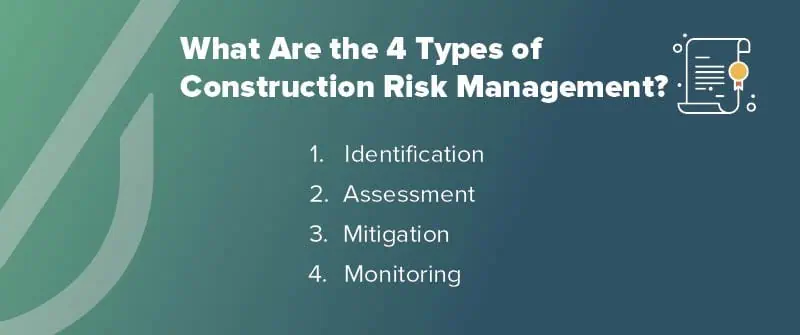
What Are the 4 Types of Construction Risk Management?
People in the industry generally agree on four common types, or portions, of construction risk management. Sometimes, different collaborators will work on the various pieces before a team comes together to create a comprehensive construction risk management plan that includes elements of all of them.
- Identification. Construction risk management generally begins with identifying, or anticipating, safety risks that are likely to occur on the job. This could mean anything from financial concerns to safety hazards to weather conditions and more. Addressing a safety risk before it happens is key.
- Assessment. Upon being identified, risks must be assessed to ascertain their likelihood of occurring, as well as who, what, and how they would affect the project and its timeline. A thorough risk assessment helps prioritize the most critical threats.
- Mitigation. At the end of the day, the goal of construction risk management is to decrease the chance of the anticipated issues occurring, or to eliminate the threat of them completely. This part of the plan is vital for handling multiple risks simultaneously, especially in complex or large-scale builds.
- Monitoring. Risk management isn’t a set-it-and-forget-it line of work. Managers must continue to track project performance while monitoring activities and minimizing risk at every stage. This typically requires regular inspections and strong communication across teams.
Manage Your Construction Risk Management with myCOI
Construction risk management is crucial for keeping people safe, protecting project stakeholders, minimizing financial losses, and, ultimately, ensuring success on a job.
Ready to learn more about reducing risk for your contractors, subcontractors, stakeholders, and company as a whole? Reach out today for an expert team’s advice on how to manage construction risks.