


Events can be an excellent way for businesses to market themselves, for industry professionals to gather together in one space, or simply to have a fun time with guests. However, they can also become a breeding ground for unfortunate circumstances that can lead to costly litigation.
Often, event holders will want to obtain event liability insurance in order to protect themselves from claims made against them in the case of injury to guests or damage to a venue. Additionally, if you’re a venue renting out a space for events or perhaps hosting an event where exhibitors show up, you should consider requiring renters and exhibitors to get coverage of their own. This will ensure that you’re not held financially responsible for any accidents that they cause.
illumend, from myCOI, is the AI-native COI management platform that helps businesses more effectively understand insurance verification, manage their vendors’ COIs, and maintain compliance. Follow along in the latest addition to our continuing Certificate of Insurance 101 series, where we’ll discuss what you need to know about certificates of insurance for events.
What Is a Certificate of Insurance for Events?
Certificates of insurance Services (aka insurance certificates, aka COIs) are documents that verify the existence of a current insurance policy. They summarize a policy by providing important coverage information, including the policyholder’s name and contact information; who is providing the insurance for them; the type of policy they’re being insured for; its policy limits, additional insureds, effective dates, and expiration date; and the receiver of this proof of coverage (aka the certificate holder, aka you if you’re the one verifying someone’s coverage).
COIs are not insurance policies themselves—they simply provide proof of one. Think of them like the car insurance card you might keep in your glove compartment. These cards provide a summary of essential policy details so that you can quickly provide proof of your coverage. It’s not a policy itself but a quick look at the coverage you carry when you need to showcase it.
What Is the Purpose of an Events Certificate of Insurance?
The purpose of COIs is essentially to act as an insurance policy, need-to-know one-pagers. They are useful because they’re less dense than actual insurance policies and provide all of the details a hiring party would need from a vendor, as well as, importantly, evidence of its existence.
It is your due diligence as someone hiring a third-party service provider, contractor, event exhibitor, or other vendor to ensure that they have adequate coverage in place for an event or project. You also need to make sure that they meet contractual standards and comply with state- or industry-sanctioned requirements. COIs are the easiest way to do so.
Obtaining proof of coverage in the form of certificates of insurance for vendors you work with is critical for both them and your business. In the case of accidents or damages that could lead to claims and lawsuits, you don’t want them held financially responsible—or you, for that matter. You want their insurance provider to step in and provide coverage. The only way to confirm that this will be the case is to verify that they have the necessary coverage in place.
What Is a Valid Certificate for Insurance for a Special Event?
Unfortunately, vendors are not always honest when it comes to their insurance verification, making this process extremely important. A COI is considered valid when it meets the following criteria:
- It is issued by a verifiable, currently practicing insurance provider.
- It is issued by the vendor’s insurance provider, who issued the policy in question.
For your company’s purposes, you’ll also need this to be true of any COI you receive:
- It represents the vendor for whom you are trying to verify coverage.
- It represents the policy for which you are trying to verify coverage.
- It meets your vendor’s COI requirements as outlined in your official request to them.
What Is a Certificate of Insurance For a DJ?
Let’s go over an example of when a vendor might need a COI. DJs, professionals who play recorded music for events, would, like other event vendors, be expected to provide proof of their general liability insurance. If they didn’t, they could be held liable for injuries that happen during a performance, be fined for property damages, or face other legal penalties. In fact, those who refuse to provide a COI would probably not be an event planner’s first choice for a DJ since refusing to do so is generally a sign of unprofessionalism, and they’d be exposing that business to unnecessary risk.
When You Might Need a Certificate of Insurance for an Event
There are countless scenarios where a COI isn’t just a good idea — it’s a requirement. Any time you’re hosting an event that involves outside vendors, equipment rentals, large gatherings, or potential safety hazards, a COI is your first line of defense against unexpected costs.
Here are a few common examples:
Trade shows or expos – With multiple exhibitors, there are multiple opportunities for mishaps. Ask each exhibitor for a general liability COI so you’re not left holding the bill for damages.
Weddings and private celebrations – Ensure that all vendors, including caterers, photographers, and the venue itself, can provide proof of coverage. You should also consider purchasing your own one-day event liability policy to cover incidents that may occur during your celebration.
Music festivals and concerts – Require COIs from all performers, food vendors, security providers, and the venue. These events often involve higher risks, such as crowd injuries, property damage, and weather-related cancellations.
Sporting tournaments or high-activity events – Whether it’s a charity 5K or a community soccer match, the risk of injury is higher, making insurance coverage essential.
If your event falls into one of these higher-risk categories, the safest move is to assume you’ll need a COI — and to start collecting them well before the first guest arrives.
When Do You Need a Certificate of Insurance From a Vendor?
The answer to this question is typically a resounding “ASAP.” That is because as soon as a vendor enters your premises, they can get into an accident that leads to property damage, bodily injury, etc., which could make your business face financial ramifications. In order to avoid the possibility of uninsured claims headed your way, ensure that your vendors are covered by requesting COIs from them before they begin working for or exhibiting with you.
How Do I Get an Insurance Certificate?
To get a COI as a policyholder or event exhibitor looking to verify your own coverage, you’ll go to your insurance provider and outline your hiring party’s requirements, and they will assist you in generating the document. To get a COI as a hiring party or event host looking to verify the coverage of another party, you’ll make a COI request to them, and they’ll return the certificate to you as soon as possible. We’ll discuss this more below.
How to Obtain a Certificate of Insurance For an Event?
Let’s get specific when it comes to certificates of insurance for events. There are many cases when you could need a COI for an event, but here are a few examples:
- You’re hosting a trade show event with multiple exhibiting vendors. You don’t want to be in charge of every booth’s insurance or be held responsible for the damages that someone may inevitably cause, so you should ask for a general liability COI from each exhibitor.
- Congratulations, you’re getting married! Make sure that your vendors, such as the caterer, photographer, and the venue itself, have COIs to prove their event insurance coverage and help mitigate risks associated with accidents that could happen at the ceremony. You should also consider obtaining one-day event liability insurance or special event insurance for the event.
- As the organizer of a music festival, you have a lot to manage. By requesting COIs from all performers, food vendors, security personnel, and the festival venue, you can protect your business against potential liabilities such as injuries, property damage, or weather-related cancellations.
To get a COI for each of these events, you will need to make an official request to each vendor.
How to Request a Certificate of Insurance from a Vendor?
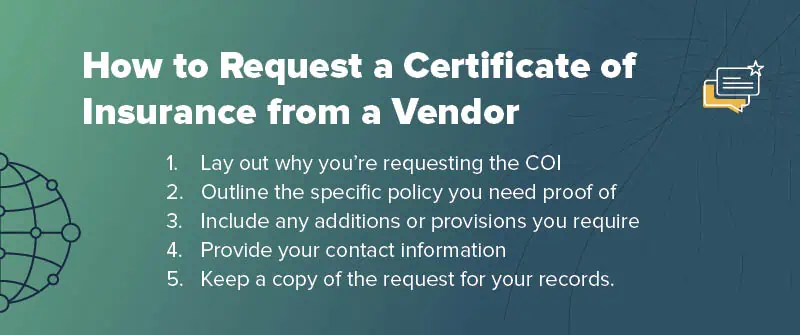
Now that we’ve covered some common scenarios for when insurance certificates are necessary for events, let’s dive into how to request one officially. Follow these steps to make a COI request to a vendor:
- Lay out why you’re requesting the COI.
- Outline the specific policy you need proof of and any coverage details, such as minimum coverage limits, that you need. Make sure that your request aligns with the certificate of insurance requirements for your state.
- Include any additions or provisions you require as well, such as asking them to add an additional insured endorsement to their policy, extending coverage to your business.
- Provide your contact information (since you will become the certificate holder).
- Keep a copy of the request (e.g., mailed letter, email, etc.) for your records.
From there, the process will continue like this:
- The vendor will take the request to their insurance provider.
- The insurer will verify that its coverage meets your requested requirements or make changes so that it does.
- They’ll generate the COI, and one of the two parties will deliver it to you as soon as possible.
- Verify the document to ensure that it meets your needs.
- Keep the COI for your records.
Learn more about how to check if a business has insurance.
Can I Issue My Own Certificate of Insurance Online for Event Liability Insurance?
As you can probably tell by the formal process we’ve just laid out for obtaining an official COI, you cannot simply issue your own business certificate of insurance for events online. There are many insurance certificate examples online; however, these can be helpful for gaining a better understanding of the documents, but you shouldn’t ever attempt to generate your own certificate online. In fact, if a vendor does this to you, it’s considered fraud and an invalid COI that does not adequately confirm their coverage.
illumend, from myCOI: The Events Compliance Partner You’ve Been Looking For
Managing your downstream risk during events can be difficult and time-consuming work. The more years of experience you have working in the space of insurance and compliance for events, the easier it becomes. In many cases, it can take a team of practitioners to help ensure your compliance. Find out how Lumie is the one to help you with your COIs for events. Book a demo today to learn more.
How illumend verifies this automatically
illumend, from myCOI, is the AI-native insurance compliance platform built for exactly this. Its AI, Lumie, reads every certificate and endorsement, checks the coverage against your contract requirements, and returns a compliance decision in minutes. Lumie reviews 100% of documents automatically, with no review queue, and tells your third-party partner in clear terms what is missing. You get the answer, not just the definition.