

Social inflation affects our industry in big ways, but many of us don’t understand what it is or how it’s doing it. Here, we’ll break social inflation down, discuss it, and gain an understanding of what we can do as an industry to combat it.
What Social Inflation Is
In addition to general economic inflation, social inflation captures how insurance companies’ claim costs can rise above general economic inflation coupled with societal preferences over who should absorb risk. Insurers can modify pricing models or loss reserves to mitigate general economic inflation, which is caused by unpredictable factors such as rising expenses. Social inflation, on the other hand, may result from a variety of different factors and is harder to hedge bets against.
The impact of these and other issues in the legal landscape can be intensified by third-party litigation funding. Factors that can affect social inflation include longer legal proceedings, tort reforms (or rollbacks therein), mistrust of corporations, emotionally charged jury trials, and an increase in the number of extensive jury awards. The social nature of this form of inflation implies that the public is growing more skeptical of business, and more pointedly, large corporations; this is allowing for more of a sympathetically-leaning juror landscape.
What the Effect of Social Inflation Is
When social inflation occurs, insurers pay out higher claim amounts and loss ratios which drives up policy costs. An inflation rate like the Consumer Price Index (CPI) may be used to compare the impact of social inflation components on claim losses over time with inflation. Social inflation can’t be measured by standard means like the CPI.
Commercial automobile, professional liability, product liability, and directors and officers liability are just a few of the insurance lines that are most vulnerable to social inflation. However, private passenger automobile insurance appears to be under pressure as well. This doesn’t mean that other lines of insurance aren’t affected, but rather the social pressure in these lines is higher as per the previous section where we discussed how public sentiment toward big business is changing. Let’s talk about that a bit more.
One of the more interesting things to come from this is newer juror tactics used in court cases to play more heavily on the emotions surrounding safety and survival, often referred to as “Reptile Theory.” Humans tend to side with things we find that help us with our own survival. Employing empathic devices, a lawyer can leverage Reptile Theory to put the jurors in the shoes of someone else. By doing this, defendant payouts have increased because jurors see themselves as the plaintiff. This has led to a desensitization to massive awards due to the media playing these up. Social pressure comes from this, thus social inflation creeps in.
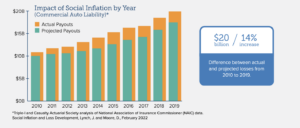
This graphic from iii.org shows the impact social inflation is having on the industry.
What is Driving Social Inflation?
An investor providing money to attorneys or clients in return for a financial stake in the outcome of a legal case or arbitration is known as third-party litigation funding (TPLF). This kind of funding is usually described as a non-recourse loan because it does not have to be repaid if a case is lost or dismissed. Non-recourse loans are also known as legal funding, third-party litigation funding, and alternative litigation funding (ALF). This fast-growing multibillion-dollar industry, valued at $17 billion and predicted to reach $30 billion by 2028, is increasing and is adding to the social inflationary environment we live in today. It’s essentially gambling on court cases, and it’s legal.
According to research, TPLF can cause social inflation by allowing for longer litigation, making insurance coverage more expensive. There are several other aspects of TLPF that may cause problems. The hedge funds behind many of these TPLF efforts operate without disclosures and safeguards and can keep the litigation going in hopes of their side winning.
So What Can be Done?
When social inflation occurs, there are a few things that you can do to control it. First, you can try to tailor the risk profile of your customers so that all of them pay roughly the same amount. If you can’t do that, you can try to separate customers by certain factors like age, sex, or location to create artificial differences in the risk profile of your customers so that they are all paying roughly the same amount. If these options don’t work, you can also try to lower your own costs by improving the quality of your service. This can be achieved by simplifying your policies, automating specific processes (like how you collect and analyze the mountains of certificates of insurance), improving the accuracy of your data, and so on.
Increased claim costs caused by social inflation may jeopardize insurance coverage affordability. Policyholders, insurers, and policymakers (legislators, courts, regulators, etc.) all play a crucial role in developing solutions-oriented conversations.
Be Prepared. It’s Affecting Your Bottom Line Already.
Social inflation occurs when one group of customers is charged low rates while others are charged high rates. When this happens, the profit margin on premiums for the low rate customers will be lower than the profit margin on premiums for the high rate customers. As a result, those low rate customers end up subsidizing the high rate customers while the company loses profit on the high rate customers.
Social inflation is the natural result of any risk transfer system that relies on a few people to bear the burden of risk while everyone else is protected by insurance policies that are priced too low. The trust the public is losing in businesses, specifically large corporations, lends to jurors finding defendants guilty at a larger volume which increases payout and increases costs.
If you want to reduce social inflation in your company, you’ll need to first understand how it happens. Once you understand the cause, you can take steps to reduce social inflation in your organization.
Key in all this is keeping claim costs as low as possible. One way to do this is automating your certificate of insurance (COI) tracking process. myCOI makes this process SO. SO. SIMPLE. We invented the space, and as such, have everything you need to erase the worry that tracking COIs can create.
Book your free, tailored demo today to see just how simple it can be!